
![[peakpod] Instagram link image.](https://static.wixstatic.com/media/d1bec8_2cf51a7a74d34080a02ebb8de5954293~mv2.png/v1/crop/x_192,y_156,w_327,h_331/fill/w_45,h_43,al_c,q_85,usm_0.66_1.00_0.01,enc_avif,quality_auto/d1bec8_2cf51a7a74d34080a02ebb8de5954293~mv2.png)
![[peakpod]YouTube link image.](https://static.wixstatic.com/media/d1bec8_0134305f8385471db157efa2f4728bf7~mv2.png/v1/crop/x_109,y_175,w_491,h_404/fill/w_45,h_37,al_c,q_85,usm_0.66_1.00_0.01,enc_avif,quality_auto/Youtube%E3%82%A2%E3%82%A4%E3%82%B3%E3%83%B3.png)
Column
Roof tents can be installed even on light vehicles! Types and how to choose them
>
>
Roof tents that can be installed even on kei cars! Types and how to choose the right one
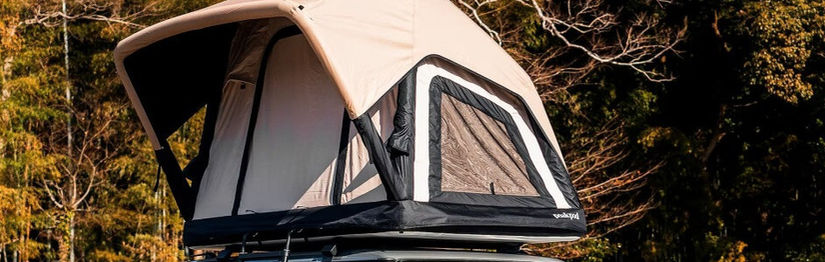
Even in a kei car, it's spacious and comfortable! A new way to travel is made possible with a roof tent.
More and more people are opting for roof tents as a way to make their kei cars (mini-vehicles) more comfortable.
However, if you don't properly understand how to install it and how it's compatible with your car, it may affect stability while driving or make setup difficult. If the size doesn't fit, it will be difficult to sleep comfortably and will impair usability, so checking beforehand is essential.
Prices vary depending on the model, so it's important to choose one that fits your budget.
Below, we'll summarize the key points for choosing a roof tent that's easy to use with a kei car (mini car), from the basics of installation to size selection and price trends.
Enjoy comfortable overnight stays in your minicar! Types of roof tents and how to install them.
For kei cars (mini cars) with limited interior space, roof tents, which allow you to set up a sleeping area on top of the car, are an item that can combine mobility and comfort. Below, we will introduce the basic types of roof tents and their features and how to use them.
What is a roof tent?
A roof tent is a tent that is attached to the roof of a car. Even in small cars where it is difficult to secure sleeping space inside, you can rest comfortably by setting up a sleeping area on the roof. Unlike typical tents that are set up on the ground, a key feature is that it can be set up on a flat surface and is less affected by weather conditions.
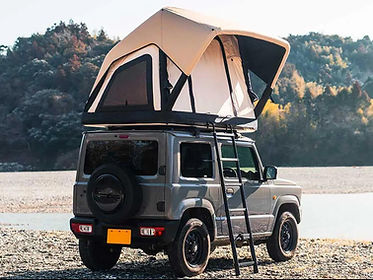
What types of roof tents are there?
Roof tents come in several types based on their deployment method and structure, and can be categorized as follows:
Softshell
It has a fabric-based construction and is relatively lightweight. It's also reasonably priced, making it a good choice for those buying a roof tent for the first time. While setting it up can be a bit time-consuming, it takes up minimal space when stored.
hard shell
It opens and closes smoothly and folds compactly for storage. Its sturdy exterior provides excellent wind resistance and insulation, making it a highly comfortable option. However, its weight may make installation difficult in some compact cars.
Airframe
Its unique structure, which forms the frame by inflating it with air, makes it extremely lightweight. Because it doesn't typically use a metal frame, it's easy to handle and set up, making it suitable for beginners. It's also highly packable, making storage easy when not in use.
How do I install a roof tent on a kei car (mini car)?
To install a roof tent, you need to attach a "base carrier (bars)" to the roof of your car. This carrier will serve as the base that supports the tent itself.
When installing a roof tent, it's important to choose a base carrier that matches your vehicle, as there are limitations on the type of carrier and its weight capacity. Also, since bolts and specialized fittings are used to secure the tent, following the installation instructions is crucial for safety. The following points should also be checked for added peace of mind.
- Is the weight capacity of the base carrier compatible with the weight of the roof tent? - Do you have the necessary tools for installation (spanner, step ladder, etc.)? - Is it light enough to be installed by one person, or does it require two or more people?
Especially for first-time installations, it's a good idea to consider hiring a retailer or a specialist. If you prioritize safety and reliable installation, consulting with knowledgeable staff will give you peace of mind during the process.
Choosing the right size roof tent for a kei car (mini car)
When choosing a roof tent, size is a very important factor. Especially for light vehicles, there are restrictions on the size of the vehicle body and the roof's load capacity, so if you don't choose the right size, it could affect safety and driving performance. Below, we will introduce some points to consider when choosing the perfect roof tent size for your light vehicle.
Points to check when choosing a size
Vehicle roof size
First, check the width and length of your car's roof. If the tent extends significantly beyond the roof, it will be more susceptible to wind while driving, which can affect stability. Some products specify compatible car models, so it's a good idea to check that as well.

Don't forget to check the load capacity
When choosing a roof tent, it's important to check that the weight is compatible with the specifications of your vehicle and roof rack. Every vehicle has a weight limit that can be carried on the roof, and exceeding this limit may affect safety while driving. It's a good idea to check your vehicle's owner's manual and the carrier manufacturer's compatibility information beforehand.
The ideal size is one that's neither too big nor too small.
A roof tent that is too compact can feel cramped when sleeping, making comfortable overnight stays in the vehicle difficult. On the other hand, if it is too large, it can increase wind resistance and disrupt the balance with the vehicle, potentially affecting driving stability and fuel efficiency.
Therefore, when using it in a kei car (mini car), it's important to choose a size that is well-balanced, taking into account the car's size, load capacity, and the number of people using it. Consider your travel style and ease of installation and storage comprehensively.
Points to consider when comparing the prices of roof tents
The price of roof tents varies greatly depending on the product type and functionality. Choosing solely based on price may lead to dissatisfaction with usability and safety, so it's important to make a comprehensive decision that includes not only price but also functionality and ease of use.
Understand the price range for each type.
Softshell: Affordable and easy to implement
It features a fabric-based construction, making it lightweight and relatively affordable. While it requires a little effort to set up, it's a good model to consider for first-time campervan users.
Hardshell: High functionality but high price
It offers excellent insulation and durability, and is easy to set up and pack away. However, it is heavy, so caution is needed when installing it in a small car. The price is also set on the higher side.
Airframe: Good balance of functionality, lightness, and price.
Thanks to its unique self-supporting structure that relies on air inflation, this tent is extremely lightweight and easy to handle. Setup is quick and easy, and it boasts excellent storage capabilities. While offering all the necessary features, it's not excessively expensive, making it a great choice for those considering purchasing a roof tent for a small car.
Check what is included in the price.
Check the functionality.
Whether the product offers a level of usability commensurate with its price is also a key point to consider. Check if features such as ease of setup and dismantling, storage size, breathability, and waterproofing suit your needs.
The presence or absence of accessories also affects the price.
It's also important to check whether accessories like mats, ladders, and storage bags are included in the set. Even if the initial price seems low, the total cost might end up being higher if accessories are sold separately.
When comparing roof tents, it's important to consider the total cost, including not only the tent itself but also shipping, accessories, carriers, tools, and more. Don't be misled by the apparent price; comparing them under the same conditions will lead to a more satisfying choice.
Peakpod rooftop tent - also compatible with kei cars!
Roof tents vary greatly in price depending on the type and features. Especially when using them with a kei car (mini car), "lightness" and "ease of setup" are important factors to consider when choosing one.
At peakpod, we sell an ultra-lightweight air-frame rooftop tent weighing approximately 17 kg to meet those needs.
It can be easily installed and removed by one person, and folds compactly for storage, making it convenient for carrying. Its 2-way design allows it to be installed not only on the car roof but also on the ground, expanding its range of uses.
For those who prioritize a balance between size, weight, and price, this design is easy to use without any hassle.
If you're looking for a roof tent that can be used even on a kei car (mini car), be sure to check out Peakpod's products.
Roof tents and car roof tents that attach to the roof of your car, and a column about useful camping gear.
01
Roof tents can be installed even on light vehicles! Types and how to choose them
02
What is load capacity? Basic information you need to know before installing a roof tent on a Jimny
03
Rooftop tent sales information and points to check before purchasing
04
Types of rooftop tents and how to choose them
05
How to choose the carrier needed for car tent installation
06
Preparations and precautions for installing a car tent on a vehicle
07
How to choose a lightweight tent for your car roof and storage tips
For roof tents on kei cars, try PeakPod.
Company Name
N.FACTORY Co., Ltd.
main office
337-1 Komura-cho, Matsuyama City, Ehime Prefecture 791-1125